
The other day, I read an 879-year-old blog
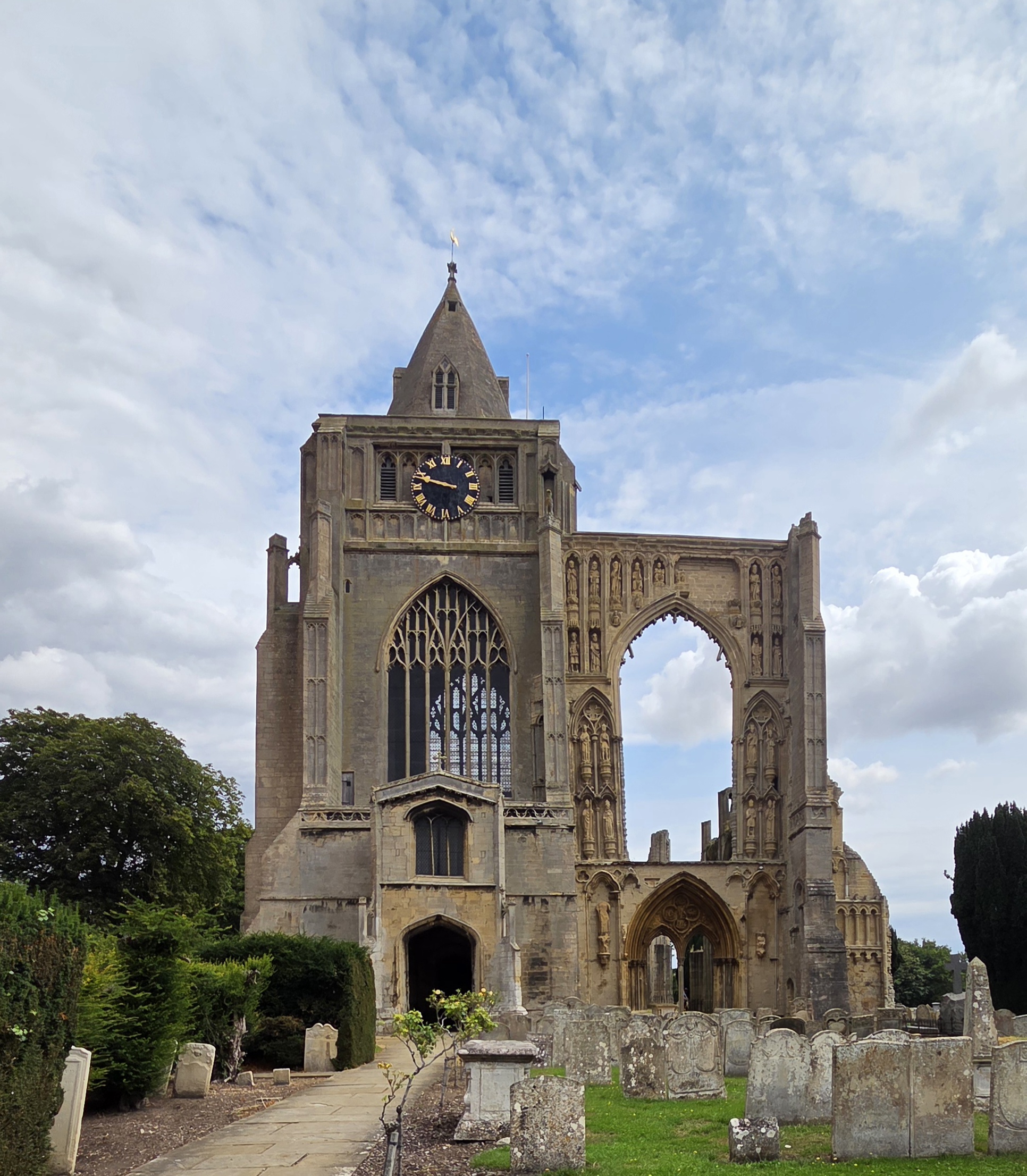
As we were walking around a tourist spot, I saw a blog from over 800 years ago. So, I wrote a blog about it.
No, genuinely, I saw a 879 year old blog a couple of weeks ago… and yes, now I am going to do one of those ‘and it made me think…’ blogs about it.
So, here is the back story. I regularly drive the A16 through South Lincolnshire.
I should point out that I don’t do that as some sort of weird hobby, nor is it because I am cursed to visit the Tulip Queen services like some sort of weirdly provincial Lincolnshire-based equivalent of the Flying Dutchman.
I do it because I live in the area. It’s all perfectly reasonable and non-supernatural.
Anyway, the A16 passes through countryside that is, well, to be honest, very flat.
For the benefit of anyone who has never experienced the South Lincolnshire countryside, ‘Flat’ is simply not a descriptive enough word for how lacking in any sort of detail that part of the world is. It is very, very, very flat.
If your dog runs away near where I live, you can watch it run away for about an hour and a half.
It would make a flat-earth conspiracy theorist weep with joy.
If you painted the back of a relief map of the area green, you could just use either side.
It’s like being miniaturised and dropped onto a snooker table.
Flat! It’s very, very flat, is what I am getting at here.
Which is why, as you drive along the A16, you can see the Abbey that sits on the edge of the rather pleasant little town of Crowland.
Crowland Abbey from the road
From a distance, it’s genuinely bloody impressive. The Abbey is grand and very ‘gothic’. Well, OK, it’s probably ‘gothic’ or possibly something else. To be frank, my knowledge of architecture is limited, and I could Google it, but even if I am wrong, I still rather like Gothic because it sounds appropriately grand. So, let’s just go with gothic over confirmed fact, shall we?
The most striking feature is the arch. From the road, you can see what appears to be an almost impossible structure. A giant, seemingly unsupported, sweeping arc of stone.
It’s genuinely striking.
No sooner do you see it, though, but, presumably in a public spirited attempt to give people something with which to judge perspective in all the flatness, some trees hide it from view.
It’s gone from sight entirely by the time you reach Cowbit.
Yes, I do appreciate how funny the name is, and no, “Cow bit” isn’t how you say it. I honestly only mentioned Cowbit because it has a wonderful name that made it worth crowbarring it in.
So, to move things along, after months of passing Crowland Abbey, on one particularly nice day in Summer, my considerably better half and I decided to pay a visit to see the arch up close.
And on to the actual reason for this blog
We took our time and wandered around the graveyard of Crowland Abbey for a while, being all touristy and ohhing at old graves and such, until we arrived at the arch. It turned out to be attached to the main abbey and was clearly part of an originally much larger structure.
Then, while I was taking some of the pictures you can see here, a rather large rock apparently said
“Would you like to know more about the building?”
As it turned out, it wasn’t the large rock at all, but a considerably smaller, rather well-dressed lady, who had kindly taken the time to stop and chat. Of course, we said we very much would like to know more, and she turned out to be a mine of information.
Crowland Abbey, I was informed, was first established in the early 8th century and then rebuilt in the 12th and 13th centuries after devastating fires. Fascinating stuff, but even more interesting was that adorning its intricate stonework are numerous carvings. One of which, the one this article is about, dates from a very specific period in the 12th century.
 The 12th Century blog
Several of the carvings around the arch, she explained, told a story.
We were drawn to one set of carvings in particular, which we learned represented the stonemason and his tools. It turned out that they were a sort of Norman equivalent of writing ‘I was here’ or one of those ‘Constructing the living space of tomorrow (visit our show home), Sorry for any delay.’ signs that they put there just to annoy you while you while are stuck in a traffic jam waiting for a roof tile delivery lorry to unload.
Then she told us that on the other end of the archway was something that I admit hit my geek button very hard indeed. The stonemason had also carved a representation of Halley's comet.
That is incredible. There, being stared at by me over 800 years later, was a carving of a comet. It had been made by someone who saw a celestial event and recorded it.
Take a moment on that. He saw something he felt important enough to be worth recording in stone, and there it was centuries later still telling the world, ‘Hey, I was here and this amazing thing happened’.
What stunned me, though, wasn’t the thought of the momentous event being recorded; it was the fact that it was recorded by the people who built the arch. They took the time in the middle of their construction work to record what was happening in their world. They weren’t lords of the manor producing vanity projects, or astronomers wondering at the majesty of the universe. They were special, they were almost certainly important to someone, but they weren’t recorded in history. They were workers. They were artisans going about their trade. They were people who, given the opportunity, first of all recorded what they did and then commented on what was happening around them.
“I was here, I was a Stonemason, and I saw this amazing light in the sky”
While I was genuinely marvelling at this (yes, I have finer feelings as well as being a bit grumpy), our kindly narrator said
“It’s a sort of medieval blog, when you think about it”
She is right, it is. Someone thought ‘I matter, what I do matters, and what is going on in the world matters,’ and then they wrote it down for others to see. OK, chiselled it down, but same difference.
Why you need to blog and a mystical moment
‘This is me… this is what I do, this is what is happening’. That, in many ways, is the essence of blog writing. You are telling the world what you do, explaining why that matters and placing it in the context of the world around you. In your case, the world is usually your potential or current customers, but the point stands.
I turned to tell our impromptu guide my revelation… but she was nowhere to be seen.
I scanned the graveyard for her. There was nothing to be seen apart from the broken teeth shadows from the R’lyehesque tilted gravestones, and the dappled sunlight playing with the trees.
I stood in that holy place and wondered.
Was she perhaps some celestial visitor?
Was she my personal muse, sent to inspire me?
Was she the spirit of the Abbey, embodied to tell its story forever?
Was she, it suddenly occurred to me, standing over there by the gate chatting to some other visitors who had wandered in? Yes, ah, OK, there she was.
Anyway, the point is this:
Just like that long gone stonemason, your blog is you and your business waving a flag and asking to be noticed. You are commenting on your own Halley's comet event. You are taking that moment in your day to say, ‘this is me… this is what I do’.
That’s important, isn’t it?
Or if you don’t want to do that, pay me to do it for you. Either way works.
