
Does Your Website Pass My Niles Crane Test?
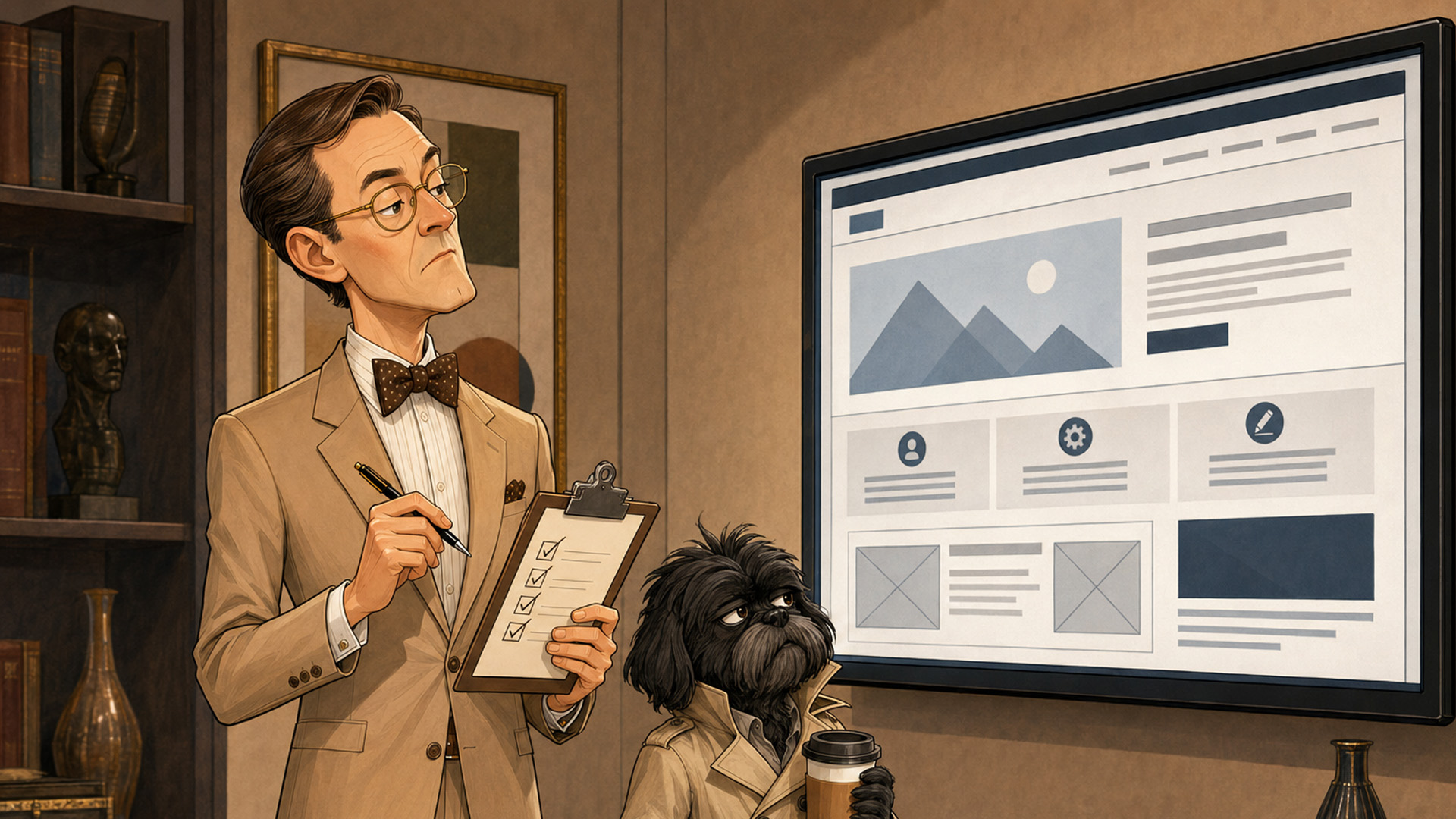
If you want to reach the right prospective clients and start the sales pipeline that leads to them choosing your services, you may want to start with the question 'Who is this website really talking to?'
One of the ways I assess the answer to this when I do a website walkthrough is something I call the Niles Crane Test.
Very nice people and businesses give me money to do a review of their websites. They do that because they want to talk to the right people when it comes to their content. I do the review, write up the report, and offer suggestions on how to amend things to reach their customers better.
The link to the website walkthrough service is here, and the benefit of taking one is simple. As a result of my report, you should be able to make your content appeal more to the people who need your services. Then, almost by default, that means you will be more visible for both SEO and Artificial Intelligence Engine Optimisation (AIEO) to your prospective customers.
What do I do on a website walkthrough and what is the 'Niles Crane' Test?
Well, actually I do quite a lot of different things, but I don’t begin by counting keywords or checking how many times a service is mentioned. To be honest, for a professional services or specialist services provider, that really isn’t as important as other factors.
I start by asking a much simpler question:
Who is your website really talking to?
One of the ways I assess the answer to this is something I call the 'Niles Crane' Test.
It comes from a joke on the 90s sitcom, Frasier, from Niles Crane (for me, by far the best character in the show). During the episode, he needs to go and accept an award for a paper he wrote. He explains it's a
“...a gripping article about a narcissistic opera singer. I called it 'Mi, Mi, Mi, Mi, Mi'”
I still laugh at that years later. It's a clever little play on words and little intelligent jokes like that were why the show was so successful.
It is also a surprisingly useful way of looking at website content, because being all ‘me me me’ is a very common problem.
Why businesses naturally talk about themselves
It is understandable that businesses focus heavily on themselves. After all, the website needs to explain who you are, what you do, and because of that, why someone should trust your services.
This is particularly true for professional services businesses such as consultants, accountants, solicitors, recruiters and advisers. Your knowledge, qualifications and experience are an important part of what you are selling.
You often see statements such as:
We have more than 20 years of experience.
We are passionate about what we do.
We pride ourselves on excellent customer service.
We provide professional, tailored solutions.
We are committed to delivering outstanding results.
There is nothing necessarily wrong with any of these claims. However, on their own, they don't really explain why any of it matters to the reader.
Which not only makes the content irrelevant to potential clients, it also potentially confuses them.
I really doubt anyone has ever said “I’m really proud of my website content, a lot of people are confused by it”
Less “me”, more “this is how it benefits you”
The principle behind the Niles Crane Test is not that you should stop talking about yourself. It is that whenever you do talk about yourself, you should connect it to a customer benefit.
For example:
‘We have more than 25 years of experience in commercial law.’
That may be true, but it leaves the reader to work out why it is important.
A more customer-focused version might be:
‘Our 25+ years of commercial law experience helps you identify risks earlier, avoid unnecessary disputes and make better-informed business decisions.’
The experience is still there; the difference is that it has been translated into something useful to the customer.
This is what I mean by moving from “me” to “to your benefit.”
Key Point - Your website should not simply tell people what is impressive about you. That’s all well and good, but they aren’t coming to you to marvel at your abilities. They have a problem that they want resolved. That’s why you need to explain what those skills of yours allow you to do for them.
Start with the customer’s situation for effective content.
Another aspect of the Niles Crane test, and therefore something I look for when reviewing a website, is where the content enters the conversation with the customer.
Does it begin with the business and its services or does it begin with the situation the customer may be facing?
Guess which one works better!
A professional services business might begin a page by saying:
We provide strategic business consultancy to organisations across the UK.
Nice, well done you. You’re worthy of our utmost respect, but that isn’t why I am here, is it? It’s important, but tell me later.
A more customer-focused opening might be:
If growth has slowed, responsibilities have become unclear or the business is no longer moving in the same direction, an outside perspective can help you identify what needs to change. We bring that perspective and help businesses across the UK steady the ship and grow revenue.
The second version begins with a recognisable problem. It lays out in general terms what the benefit is, and it gives the reader a reason to think 'Yes, this is relevant to me.'
Key Point - Once a connection to the customer's situation has been made, you can explain your service, how it helps and your experience in delivering it.
Use the customer’s language before your own terminology
Professionals often organise their websites around technical service names, internal departments or industry terminology.
That makes sense from inside the business - it may make far less sense to the customer.
A potential client for a specialist service may well not know which specific part of that service they require. They may only understand their problem and will describe it in everyday language.
They may be thinking things along the lines of:
Why are sales slowing down?
Why can we not recruit the right person?
What happens if the business cannot pay its debts?
Why is our website not producing enquiries?
How do I protect the company during a dispute?
This makes the page more accessible to potential customers. It can also make it easier for search engines and AI search tools to understand which questions the content is answering.
Remember that 20 – 25% of search is now done by voice prompt. So if your website content doesn't match that, you are missing an opportunity.
In the real world, is anyone actually making this kind of enquiry:
“Hey Gemini, I am looking for a seasoned veteran human resources expert in the specialist area of potential industrial disputes when it comes to malicious constructive dismissal claims and the necessary process surrounding disciplinary action”
Or are they saying
“Gemini, I need to deal with an underperforming employee without getting dragged through a tribunal. Can you find someone who can help?”
Key Point - Good website content begins with the questions people are genuinely asking.
Your About page is still about you
The Niles Crane Test does not mean removing your personality, history or achievements. People want to know who they will be working with. In fact, this really matters in professional services where trust, confidence, and personality often influence the decision process.
Your ‘About’ page is the natural place to talk about:
- your background
- your qualifications
- your experience
- why you started the business
- and how you approach your work
However, even here, it helps to connect your story to the customer.
Do not simply explain what you have done - Explain how it shapes the service you provide. What has your experience taught you? What kinds of problems are you particularly good at recognising? Why do clients benefit from your background? What can they expect when they work with you?
Key Point - Your story becomes far more powerful when the reader understands how it affects them.
Three 'Niles Crane Test' questions I ask when reviewing a page
When I look at website content, I often ask three straightforward questions.
- Who is this page mostly about?
- Is the page mainly describing the business, or is it helping the customer understand their problem?
- Does it explain why the information matters?
I am looking at where you talk about your experience, qualifications, technology or processes to see if you have explained what benefit they create.
And from the above, there should be a natural progression through a narrative to a next step for the visitor to take.
Does the reader know what to do next?
A useful page should also lead naturally towards a next step. That might be reading another guide, downloading a resource, arranging a conversation, making an enquiry, booking a visit, buying something or whatever the narrative and the visitor journey demands.
There is a flow to the user journey that should be respected.
If you are in the 'your money or your life' (YMYL) services, as many professionals are, then Google will expect you to have depth of information. That is a perfectly reasonable expectation when most professionals are dealing with life changing events or situations for their clients. It follows that the client will also want you to prove that you are the right person for them by answering their questions and offering related information.
YMYL content encourages that trust.
There is a conventional 'wisdom' that says you should always remove as many clicks as possible between the arrival and the sale in your user experience. That is true... but the number of clicks required may be via your extended, rich content. Don't fall into the trap of jumping to the heavy sell.
Key Point - The call to action (or better still, the call to benefits) should feel like the logical conclusion to the page, not a sales message that has suddenly been attached to the end.
Your website should make your expertise relevant
A strong professional services website still needs to establish credibility. It still needs to explain what you do. It still needs to show why you are qualified to do it.
However, all of those things need to be framed around the person reading. Your customers not only want to know what your skills and experience are, but they also want to know how that knowledge helps them. They don't want to know which services you offer; they want to know which problem those services can solve.
They don’t want to know that you have experience. They want to know how that experience will make their situation better.
That is why the Niles Crane Test is one of the ways I look at a website.
It helps me identify where a business is talking too much about itself and where the content could work harder for the customer.
The principle is simple:
Less “me.” More “this is how it benefits you.”
The Call to Benefit at the end.
If you were wondering what a call to benefit is, this is one. At The Content Generator, I help professional services businesses turn their knowledge and experience into clear, useful and genuinely human content so they attract more clients.
A website content review can show you where your message is working, where it is becoming too focused on the business and where potential customers may be losing interest.
