
Here’s Why I Stopped Using Calls to Action
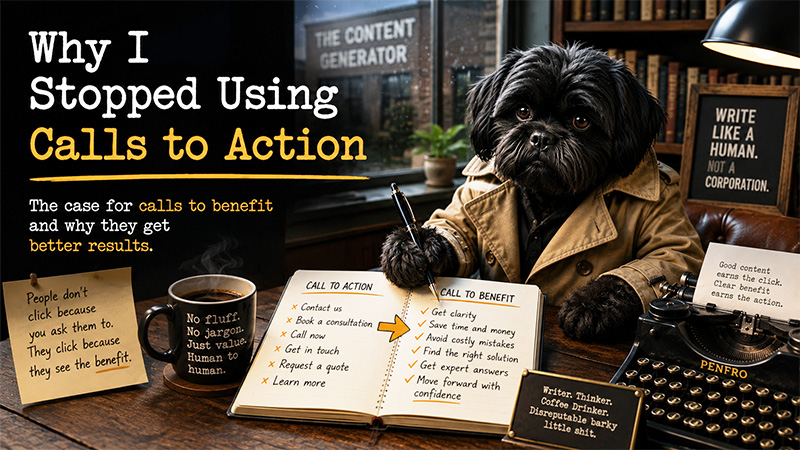
Over the last few years, I've gradually stopped thinking about ‘calls to action’, and it has had a beneficial effect on my clients.
They are a traditional part of the content, aren't they, though?
Well, yes, a call to action is needed in some form, but do they actually do what you want them to do?
Have you been on the internet today?
If so, how often have you seen these buttons?
"Contact us today."
"Book a free consultation."
"Call now."
"Get in touch."
I am guessing you can remember seeing them a lot and have probably forgotten even more.
They are the ‘call to actions’ we assume we need to get the visitor to convert. They are standard practice, and everyone assumes they work…
So why have I pretty much stopped using them?
The Problem with Traditional Calls to Action
Over the last few years, I've gradually stopped thinking about ‘calls to action’ and started thinking about ‘calls to benefit’. The difference has had a surprisingly positive effect on the way I write websites, blogs and sales pages.
If you have read my blog on the Niles Crane Test or seen me speak, you will know that I very much suggest putting the client at the heart of everything you do. Not you, not your needs, not your motivations… the clients.
When those needs are met by the services you provide, the clients come to you. If those needs are not met by your services, they are not the right client.
The traditional call to action focuses on what you want the client to do.
- Contact us.
- Book a meeting.
- Request a quote.
And so on.
From a business perspective, that makes perfect sense, after all, you do want people to contact you. However, imagine you've just walked into a shop to buy a new jacket and, before you've even looked around, someone says:
“Go to the till and buy the jacket I recommend”
As much as I hate shopping, even I would be reluctant to accept their kind offer of blindly buying whatever they want me to buy.
Not because there is necessarily anything wrong with the jacket. In fact, it could very well be the perfect jacket for me.
The problem is I currently haven’t seen the value in the jacket.
Here is a Harsh Truth – Your Clients Don’t Want To Talk To You!
Why don’t they?
Well, ask yourself this... when was the last time you woke and thought, ‘Ohhh, a nice chat to an accountant/solicitor/recruiter would make my day complete. I’ll just call one”
That's not how the customers work.
What they actually want isn’t a chat with you. What they want is:
- reassurance
- answers
- a solution to a problem
- to avoid making an expensive mistake
- expert guidance
Speaking to you is simply one possible route to achieving that benefit. That's an important distinction because, not only do many people have an understandable general resistance to spending time on a call, but there is also growing evidence of that reluctance increasing in the new generation of customers.
In short, your call to action is probably saying… ‘do this thing you really don’t want to do’
Using A Call to Benefit Changes the Conversation
What I am essentially suggesting doing is changing the message from ‘do this for me’ to ‘do this for you’.
Instead of asking someone to take the action, you tell them what they will gain from it.
Some examples
Traditional CTA sign-off for a blog
· Call us now to book a free telephone consultation
Call to Benefit sign off
· Call us and let's spend 30 minutes finding out whether there's a quicker, simpler way to solve your problem.
The difference here is that the second sign-off explains what the benefit of making the call will be. It is offering a benefit in exchange for the client taking the time to pick up the phone and have the conversation.
Here is another one based on a client that may, from their perspective at least, have an instant, very serious problem
Traditional CTA button
· Contact our team
Call to Benefit button
· Emergency? Click Here for Help
The Call to Action is an impersonal and vague invitation to have a chat with some faceless person on a team somewhere.
The Call to Benefit button says ‘I see you have a problem, this button is the gateway to the solution to it’
Call to Benefits sell Outcomes, CTAs sell Processes
For me, that difference between outcome and process is really the crux of all this, and it is something I see repeatedly with professional service firms.
A solicitor promotes an appointment.
An accountant promotes a meeting.
A recruiter promotes a vacancy.
A business consultant promotes a discovery call.
While those are the right things to happen on the journey to the client becoming a customer, none of them is what the client actually wants.
The client wants peace of mind about a legal issue.
They want to deal with their tax and pay less if possible.
They want the right employee for their team and avoid a bad hire.
They want their business to grow and need advice.
The appointment is simply how they get there, isn’t it? Yes, OK, we all know what those processes are, and yes, maybe you can expect the prospect to understand that an appointment will be needed, but until you have built trust, created confidence and given a good reason, why should your process matter to the client?
Think of it this way. Look at the appointment, consultation or contact as just the transportation that takes them along the journey to using you and your services. When was the last time your solution to reaching somewhere you needed to be was to jump in your car and drive in a random direction? Asking people to take action without the understanding of why they need you is doing exactly that. You want them to undertake the process of a journey without having a destination to put in the satnav.
If you have…
"If you'd like to know more, contact us today."
On your website, it’s fine as a process, but it isn't particularly motivating because the benefit of ‘knowing more’ is not there.
Instead, try something like:
"If you're wondering whether the same approach could work for your business, let's have a conversation. Even if we decide we're not the right fit, you'll leave with a clearer idea of your options."
Now you're offering value before you've even spoken, you have also defined the benefit and, behold, the holy grail of all lead generation: you have also trimmed down the lead to a warm one that knows what to expect.
Have good, expert content that leads naturally to a call to benefit, and you will have more success than with a call to action.
Want a few statistic-based and confidence-building points here that prove the importance of this? Well, OK then. Research from LinkedIn found that 73% of B2B buyers see useful expert content as a more trustworthy way to judge a business than its traditional marketing materials, while 86% are more likely to include a business in their buying process after engaging with its content. So, with a call to benefit approach, by the time that potential client contacts you, they already understand the benefit, have some confidence in your expertise and know what to expect. You are no longer trying to make them call you, you are simply giving them the final reassurance they need to take the action. If, at that stage, they are so far down the route of using your services, they would now need a good reason not to use you.
How I Approach Call to Action Content Analysis
When I review a website, I spend surprisingly little time looking at the buttons themselves. I am not looking at the function of the button as such. Instead, I look at what happens immediately before them and what that all means to the visitor.
· Has the page earned the desired click?
· Has it answered the visitor's questions, so the click matters to them?
· Has it demonstrated understanding of the client’s problem?
· Has it made the benefit of getting in touch crystal clear?
If it has done the above, the wording on the button just needs to reflect the customer need enough to finish the job.
If it hasn't, changing what is on the button probably won't make much difference anyway, because for a call to benefit button to have maximum effect, it needs to be the end of a series of call to benefit prompts and strong, helpful content.
Good content doesn't push people into action. It helps them see why taking action is in their own best interests.
That's why I stopped thinking about calls to action, and started writing calls to benefit instead.
When your content calls to benefit, you are matching your clients to your services and that makes for the perfect warm contact.
If you would like to see whether you are reaching out to your clients and customers in the right way, just pop over to the website report page, book yourself in for a Zoom when it suits you. Let’s see how I can help more clients choose you as first contact. Cost is all on the page as well, so you can see just how little all that potential benefit will cost you.
