
The Accidental Content Creator. Giving Someone the Responsibility for Content Also Means Training Them.
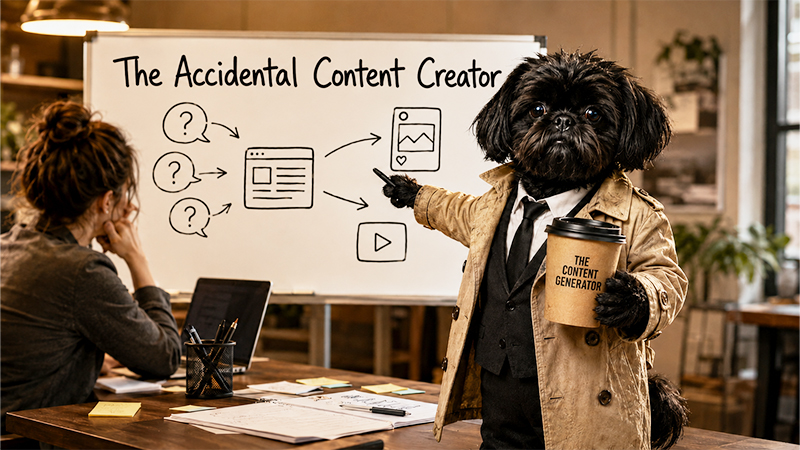
It’s a constant source of frustration for creators that content is often treated differently from other business responsibilities.
Would you give someone who can 'add up a bit' access to your accounts system and expect them to work everything out for themselves? Would you ask someone to 'just do’ the health and safety with no training, or the data protection, or run that dangerous machine? Yet, businesses often do this with content, which is one of the most important parts of their sales process.
“Could you just pop a blog on the website?”
It sounds like a simple request. So does asking someone to update a web page, create a newsletter or record a short video. It isn't, though, and in many smaller businesses, these jobs are given to someone who already has another role. They might work in administration, sales, recruitment, customer service or business development. They know the company, and they can write a perfectly good email, so that must mean they can also take care of the content, surely?
Just like that, they become the company’s accidental content creator.
Content creation is a learned skill!
Writing a blog is not simply a matter of filling a page with text, and recording a video requires more thought than pointing a phone.
Effective content starts with decisions:
- Who is this for?
- What do they want or need to know?
- Why should they care about this subject?
- What is motivating this customer to respond positively to my content?
- Which format will communicate the idea most effectively?
- What do we want the reader or viewer to understand or do next?
Without those decisions, content creation is just filling an empty space.
Key point: Dismissing the value of content is dangerous because it is possibly the single most important factor in your sales chain. It is the first link!
Knowing the business is only the starting point
Internal content creators understand the business. Therefore, they have one enormous advantage made up of four key areas:
- They hear the questions customers ask
- They know the common misunderstandings
- They see the problems clients encounter
- They understand how the company helps to solve those problems
So, that’s the content creation problem solved, right?
Sorry, no.
There is a very important gap between knowledge and good content because the knowledge of these things doesn’t become good content by default.
In fact, experts in particular often find it difficult to explain their specialism. There are many good reasons for this, and I talk about them here.
Key Point: Content training provides a way to turn knowledge into something clear, relevant and useful.
Content without a purpose will usually fail
When people are told to produce content without being shown how, they usually begin with the most obvious question.
“What can ‘I’ write about?”
‘I’ should never be the first consideration; see my article ’The Niles Crane Test’ for why.
Without a clear purpose, businesses tend to produce the same types of content:
- repeated sales messages
- generic industry observations
- predictable ‘today is…’ day posts
- blogs based on whatever subject came to mind
- content that doesn’t differentiate their business from competitors
repeating this cycle just makes the business more efficient at producing content that nobody needs.
Key Point: The purpose of your content will not auto-generate itself. You need to start with purpose.
AI has made the training gap more obvious
AI can be enormously useful; in fact, I encourage people to use it when I train or mentor them.
Access to AI is not a replacement for content training, though, and if it is used in the wrong way, it will punish your SEO and AI search.
If you aren’t fully understanding the reason for producing your content before using AI, the result is likely to be the same generic page fillers that have no value... just produced at greater speed and in pointless volumes.
Key Point: AI is a tool, but like any tool, it is far more effective in the hands of someone who knows what it's for and, very importantly, what it can and can’t do.
A lack of training leads to a lack of confidence
Sometimes the biggest issue is the content that never gets produced.
Accidental content creators can spend far too long staring at an empty page wondering where to begin. They worry about choosing the wrong subject, about sounding unprofessional or perhaps writing something that a colleague will criticise.
Video can feel even more intimidating.
This uncertainty leads to procrastination. Posts become irregular, blogs remain unfinished, and the content plan, if there was one, gradually disappears.
They are not bad at producing the content as such, it's more that they have been asked to perform a role without being given a process.
Key Point: Training or mentoring provides that process. It gives people somewhere to start, a process to help develop good ideas and the confidence to create effective work from them.
What should content training provide?
When I train or mentor, I am not trying to turn every employee into a professional copywriter, filmmaker or marketing strategist. We are working on the knowledge needed to make better practical decisions. They are in an area they really weren't intending to be involved with when they started the job, or have no choice but to do because they are the only person available, often a director or owner. I am there to make that easier for them.
That includes how to go through these steps:
- choose subjects that support the objectives of the business
- explain expertise in clear, human-to-human language
- structure content so that it is easy to follow
- use AI to speed up your process without becoming generic
- create a realistic plan that can actually be maintained
I get that this is not your job, so let's make it as effective and easy as possible.
Key Point: The aim is not to make every sentence perfect. The small business owner, director or employee creating the content probably has a lot of other things to do. So, the aim is to help people create content with confidence, consistency, speed and purpose and, most importantly, do that in a way that works for the customers you want to target.
Training benefits more than the person creating the content
A trained internal content creator can make better use of the expertise that already exists throughout the business.
They can ask colleagues useful questions, recognise potential content ideas and even turn customer conversations into relevant subjects. They can also provide stronger briefs to an external copywriter, designer, videographer or agency if they choose to outsource.
Most importantly, it moves content away from being an occasional task that somebody must complete and turns it into a useful part of how the business communicates and how it plays to SEO and AIEO.
But responsibility should come with support, and if producing content is part of someone’s job, then surely training should be part of it too!
The employee may already possess the most important raw material because they have knowledge of the business, its customers and the problems it solves. What they need is a practical framework and skills that help them turn that knowledge into content people will understand, trust and act upon.
Key Point: Businesses must attract the right customers. They don’t need more people producing more content to do that. They need the people producing the content to understand how it works.
Help an accidental content creator become a confident one.
Your initial contact with customers will usually be through your content. So far from being a throwaway job, your content creator is the first link in the sales chain. It is up to them to ensure that your content does everything from attracting the client to ensuring good calls to benefit.
Such as this one...
The Content Generator provides practical training for business owners, professionals and employees who have responsibility for blogs, websites, social media and video. I help them understand what to create, who it is for and how to give every piece of content a clear purpose, so the business attracts, keeps and converts the right customers.
